What is a simple rule for building a balanced lunch?
Half the plate vegetables, a quarter protein, a quarter wholegrain carbohydrate, plus a little fat. It is the same shape Harvard and the NHS both arrived at, it needs no counting, and it is checkable in one glance. Get it roughly right most days and the details take care of themselves.
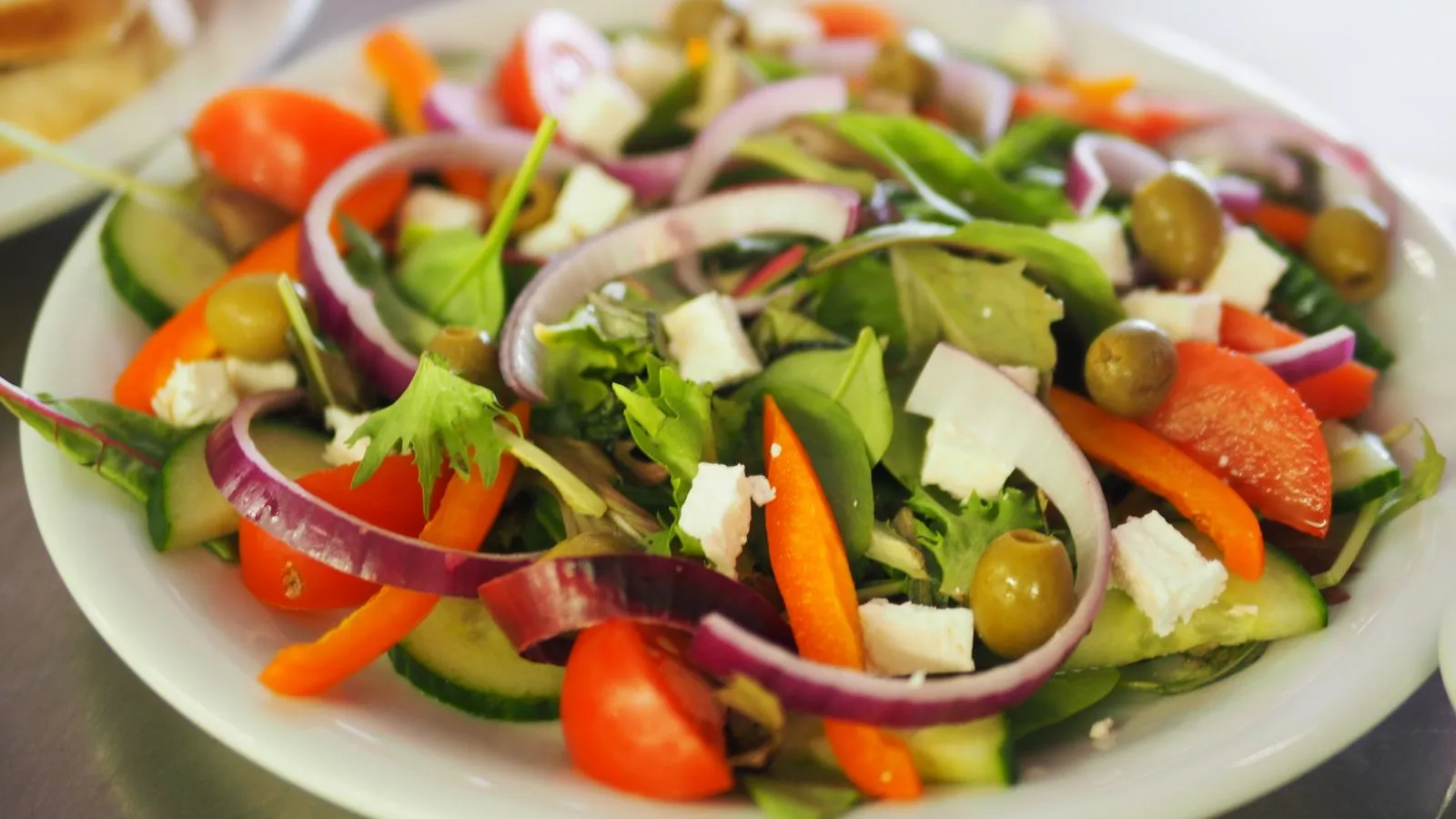
Lunch at a desk is the meal most likely to be decided in ninety seconds by whoever is standing nearest the sandwich fridge. It is also the meal that decides how the second half of your day feels.
Chapter 1 gave you a shelf to assemble from. This chapter gives you the proportions, in a form you can check by looking at a plate rather than opening an app.
The rule, in one line#
Half vegetables. A quarter protein. A quarter wholegrain carbohydrate. A little fat, and water to drink.
That is the entire system. There is no counting, no weighing, and no tracking, because the proportions do the work that arithmetic usually does. It also works on a plate, in a bowl, in a lunchbox, or eyeballed against a takeaway container.
Two national bodies, one shape#
The version most people know comes from the Harvard T.H. Chan School of Public Health, which published its Healthy Eating Plate in 2011 with Harvard Health Publishing. Half the plate vegetables and fruit, a quarter wholegrains, a quarter healthy protein, plant oils for fat, and water, tea or coffee to drink.
It was created as a deliberate correction to the United States government's MyPlate, and Walter Willett, who chaired nutrition at Harvard, was explicit about why.
MyPlate mixes science with the influence of powerful agricultural interests, which is not the recipe for healthy eating.
The UK arrived at nearly the same picture by a different route. The NHS Eatwell Guide puts fruit and vegetables at just over a third of what you eat, starchy foods at just over a third with an emphasis on higher-fibre versions, then beans, pulses, fish, eggs and meat, some dairy, and small amounts of unsaturated oils.
Why it works. When two independent bodies with different food industries, different diets and different politics converge on the same proportions, that convergence is the signal. The disagreements between them are at the edges. The middle is settled.
How you apply it at a desk. Use whichever you find easier to picture. Half the plate green is the version that survives a canteen queue. If your lunch is in a container rather than on a plate, look at it before you eat and ask which quarter is missing. Usually it is the vegetables.
Why half the plate is vegetables, mechanically#
Barbara Rolls runs the Laboratory for the Study of Human Ingestive Behavior at Penn State, and has spent decades measuring what makes people stop eating. Her work centres on energy density: how many calories a food carries per gram.
The finding that matters here is that people tend to eat a fairly consistent weight of food rather than a consistent number of calories. Her group has reported that reducing the energy density of a diet by around a fifth is associated with roughly a nine to fifteen percent drop in daily energy intake, without anyone being asked to eat less.
Water is the lever, because water weighs a lot and carries no calories. Vegetables are mostly water. One of her better known experiments served the same chicken and rice three ways, and the group who ate it as soup ate substantially less at the next meal than the group who ate it as a casserole with a glass of water alongside.
Why it works. Fullness responds to volume and weight in the stomach, not to calories, which the body cannot detect directly. Half a plate of vegetables buys you a large amount of volume for very little energy, so the meal fills you at a size you can finish.
How you apply it at a desk. Add volume rather than subtracting food. A bag of salad, a handful of frozen peas, or a soup alongside a smaller main does more for how full you feel at 3pm than a smaller portion of the same lunch, and it does not require restraint.
The quarter that decides your afternoon#
The carbohydrate quarter is where most desk lunches go wrong, and it is worth understanding what is going on rather than being told to avoid bread.
David Ludwig, professor of nutrition at the Harvard T.H. Chan School and of paediatrics at Harvard Medical School, has spent his career on this. His research programme centres on glycaemic load: not carbohydrate as a category, but how fast a particular carbohydrate arrives in your blood.
In one of his group's studies, men drank a high-glycaemic-index milkshake and were monitored afterwards. Blood sugar rose sharply, then fell below baseline about four hours later, and that fall came with strong hunger and heightened activity in a reward region of the brain. The calories were identical to the comparison drink. The trajectory was not.
Why it works. A big fast rise gets a big insulin response, which can overshoot. The dip that follows is what you experience as the mid-afternoon slump and the sudden pull toward the biscuit tin. Slowing the arrival, with fibre, fat and protein, flattens both ends of that curve.
How you apply it at a desk. Keep the carbohydrate, change the version and the company it keeps. Wholegrain instead of white, and never on its own. A jacket potato at 1pm is a different afternoon from a jacket potato with beans, cheese and a salad, because the second one arrives slowly.
What the quarter of protein is for#
Protein earns its quarter for two reasons that matter more at a desk than anywhere else.
It is the most satiating of the three macronutrients gram for gram, so it is the part of lunch doing the work of keeping you out of the snack drawer. And a body that sits for eight hours still needs the raw material to maintain muscle, which it will otherwise quietly give up.
A portion is roughly the size of your palm: two eggs, a tin of fish, a decent scoop of beans or lentils, a block of paneer or tofu, chicken, or a large spoon of Greek yoghurt. That is a portion, not a garnish, and a garnish is what most desk lunches contain.
Why it works. Protein blunts the hunger response for longer than carbohydrate at the same calories, and it slows down how quickly the rest of the meal is absorbed. Both effects point at the same outcome, which is a flat afternoon rather than a spike and a crash.
How you apply it at a desk. Check the protein first, because it is the one most likely to be missing. A shop-bought salad is usually leaves, dressing and about eight grams of protein. Adding a tin of tuna or a boiled egg costs a pound and changes the meal.
Building a lunch in ninety seconds#
Whether you are packing it, buying it or assembling it from the fridge, run these five checks in order. They take about as long to do as to read.
- Protein first. Palm-sized. Eggs, tinned fish, chicken, beans, lentils, paneer, tofu, Greek yoghurt. If you build the meal around anything else, the protein tends to become a decoration.
- Then fill half with vegetables. Anything counts: salad, roasted leftovers, frozen peas, a side soup, the tomatoes in a shop-bought box. The point is volume, and cooked vegetables give you more of it per container than leaves do.
- A quarter of wholegrain carbohydrate. Brown rice, wholegrain bread, oats, whole wheat pasta, potatoes with the skin. Enough to be a component, not enough to be the meal.
- Add a spoon of fat. Olive oil, nuts, seeds, avocado, a little cheese. It slows the meal down, carries flavour, and is what stops a virtuous lunch from being finished by a chocolate bar at half past two.
- Drink water with it. Rolls's work suggests the water inside food does more for fullness than water alongside it, so the glass is not doing the heavy lifting, but a dehydrated afternoon feels like a tired one.
- Then look at it once. One glance, one question: which quarter is missing? Fix that one thing and eat.
Applied to a supermarket meal deal, that is: pick the sandwich with the most filling, swap the crisps for a salad pot or nuts, and take the water. The rule works on the food that exists near you, which is the only kind that gets eaten.
What trips people up#
Treating salad as the protein. The single most common failure in a bought lunch. Leaves are volume, not substance. If you cannot name the protein in your lunch, there is not enough of it.
Going low fat. Fat slows digestion and makes vegetables taste good enough to eat again tomorrow. A fat-free lunch is a lunch that gets topped up with something worse at four o'clock.
Aiming for perfect proportions. It is a glance, not a measurement. A lunch that is forty percent vegetables is not a failed lunch. The rule exists so you can be roughly right without thinking, and roughly right most days beats precisely right for a fortnight.
Eating it at the desk without noticing. Eating while working reliably leads to eating more later, because you never registered the meal. Five minutes away from the screen is not indulgent; it is part of how the meal works.
These are general proportions for healthy adults. If you have diabetes, kidney disease, coeliac disease or a food allergy, are pregnant, or are being treated for an eating disorder, get personalised advice from a doctor or registered dietitian before changing how you eat.
Common questions
What are the proportions for a balanced lunch?
Half the plate vegetables or fruit, a quarter protein, a quarter wholegrain carbohydrate, with a little healthy fat and water to drink. Harvard's Healthy Eating Plate and the NHS Eatwell Guide were developed separately and describe close to the same shape.
Do I need to count calories?
No, and that is the point of a proportion rule. Barbara Rolls's research at Penn State suggests people eat a fairly consistent weight of food rather than a consistent number of calories, so changing what fills the plate does much of the work counting would.
How much protein should be in a lunch?
Roughly a palm-sized portion: two eggs, a tin of fish, a good scoop of beans or lentils, a block of paneer or tofu, or a large spoon of Greek yoghurt. Check it first, because it is the component most often missing from a bought lunch.
Why do I crash in the afternoon after lunch?
Often because the meal arrived too fast. Research by David Ludwig's group at Harvard found a high-glycaemic-index drink produced a sharp blood sugar rise followed by a dip below baseline about four hours later, along with strong hunger. Wholegrains, protein and fat all slow that curve down.
Does the rule work on a bought lunch or a meal deal?
Yes, and that is the test of a usable rule. Pick the option with the most filling, swap crisps for a salad pot or nuts, and take water rather than a soft drink. You are aiming at roughly the right shape, not at a perfect plate.
Tools that make this stick
Where an expert named a specific tool, that is noted. The rest are practical options, and at least one of them is always free.
The plate graphic as a free PDF, available in more than twenty-five languages.
This is the version to stick inside a cupboard door or on the fridge. The rule fails at the moment of packing lunch, and a picture at that moment beats a principle you read once.
The UK national guidance, showing proportions across a whole day rather than one meal.
Useful as a cross-check, and better than the Harvard plate if your diet is built on rice, roti, pasta or potatoes, since it is more explicit about where starchy staples fit.
- A 900ml lunch container with a dividerUnder the price of two bought lunches
Any two or three compartment box, glass or plastic.
The compartments do the measuring. A divided box makes an unbalanced lunch visibly obvious while you are packing it, which is the only moment the rule can still be applied.
- Open Food FactsFree and open source
A non-profit open database of packaged foods, searchable by barcode.
Bought lunches hide their protein content behind marketing. Scanning the box tells you in two seconds whether the salad you are holding has ten grams of protein in it or two.
Your one move today
Look at whatever you are eating next and name the protein out loud. If you cannot, add one thing: a boiled egg, a tin of fish, a handful of nuts, a spoon of yoghurt. That single addition is most of the difference between this rule and no rule.
Next in this series
3What tiny food swaps make the biggest difference?Chapter 3 goes smaller still: the handful of one-for-one swaps that need no plan, no recipe and no willpower, and which quietly move the average more than any diet does.New chapters go up as they are written. If you would rather not have to remember to come back, the homepage lists every series in order, so you can pick up wherever you left off.
Sources
Every quote on this page was checked against its original source before publishing.
- Harvard T.H. Chan School of Public Health - the Healthy Eating Plate, developed with Harvard Health Publishing View source
- Walter Willett, MD, DrPH - on the launch of the Healthy Eating Plate and its differences from MyPlate, Harvard Gazette, September 2011 View source
- NHS - the Eatwell Guide, UK national dietary guidance View source
- Barbara Rolls, PhD - Dietary energy density: applying behavioural science to weight management, Nutrition Bulletin 2017, Penn State View source
- David Ludwig, MD, PhD - research on glycaemic load, blood sugar trajectory and hunger, summarised in an interview for The Nutrition Source View source