What's a good 10-minute workout for someone who sits all day?
Run one circuit of five moves that cover the patterns sitting takes away: 10 squats, 10 glute bridges, 10 wall push-ups, a 20-second plank, and 10 band rows. Repeat twice with short rests. It takes ten minutes, needs no gym, and trains every major pattern your chair has switched off.
You have ten minutes before your next call. Not an hour, not a gym window, ten minutes in the room you are already in, wearing what you are already wearing. The honest question is whether that is worth doing at all, or whether it is the fitness equivalent of tidying one drawer.
It is worth doing. The research on short training is one of the more settled areas in exercise science, and it points somewhere useful for a person with your calendar.
In Chapter 1 we used the twenty seconds you already have every time you stand up. This chapter is about what to do when you have ten real minutes and want them to count.
Why ten minutes is not a consolation prize#
There is a quiet assumption behind most training advice: that a short session is a watered-down version of a proper one. Something you settle for. That assumption is doing a lot of damage to people who sit all day, because it turns the ten minutes they have into a reminder of the hour they do not.
The reason ten minutes works is not that a little is better than nothing, though it is. It is that the specific things sitting does to your body respond to frequency and to loading through range, and both of those are available in a short session.
Intensity buys back the time you do not have#
Martin Gibala chairs the kinesiology department at McMaster University in Canada and has spent two decades studying how little exercise you can do and still get the benefit. His framing is the one to keep.
We like to think of it as fitting exercise around your life instead of fitting your life around exercise.
His laboratory compared sedentary people doing a short interval protocol against people doing traditional endurance training. The interval group matched the fitness gains of 150 minutes of steady training while spending about 80 percent less time doing it.
Why it works. Effort and duration are partly interchangeable. Pushing a muscle hard for a short spell produces many of the same signals inside the cell as pushing it gently for a long one. Your body responds to the size of the disturbance, not only to the minutes on the clock.
How you apply it at a desk. You do not need sprints or a bike. For a body that has been still since nine, moving from sitting to a set of ten squats is already a meaningful jump in effort. Work at a pace where talking gets awkward by the last two reps, then rest. That is the intensity this depends on.
It counts even when it does not look like exercise#
Emmanuel Stamatakis, a professor at the University of Sydney, studies what he and his colleagues named vigorous intermittent lifestyle physical activity, which is a formal way of saying short hard bursts folded into an ordinary day.
His team tracked more than twenty thousand adults who described themselves as non-exercisers, using wrist monitors rather than questionnaires. Roughly four and a half minutes a day of vigorous movement, taken in bursts of about a minute, was associated with meaningfully lower risk across several health outcomes.
VILPA may be a promising cost-free recommendation for lowering cancer risk in people who find structured exercise difficult or unappealing.
Why it works. These were people with no gym membership and no intention of getting one. The benefit came from bursts embedded in normal life: stairs taken quickly, a fast walk to a bus. The body does not check whether you called it a workout.
How you apply it at a desk. This lowers the bar in a way that matters. Your ten minutes do not need a change of clothes, a warm-up ritual, or a name. Standing in your kitchen doing squats between meetings is inside the same category of thing the research measured.
These are population associations, not promises about any one person, and the research links activity to lower average risk rather than to preventing a specific disease. If you have a heart condition, joint problems, or you are pregnant, talk to your doctor before adding vigorous bursts.
What to put in the ten minutes#
Knowing that short works does not tell you what to do. This is where Dan John, a strength coach who has spent decades working with ordinary people rather than athletes, is useful.
His organising idea is that human beings have a small number of fundamental movement patterns, and that a sensible programme covers them rather than chasing exercises. He lists five: push, pull, hinge, squat, and loaded carry.
Why it works. Patterns are a checklist you can hold in your head. Instead of asking which of a thousand exercises to do, you ask whether today included a push, a pull, a hinge and a squat. It is much harder to build a lopsided body that way.
How you apply it at a desk. Sitting attacks specific patterns. The hinge goes first, because bending at the hip is exactly what a chair prevents. The pull goes next, because nothing in a desk job asks you to draw your shoulder blades back. The circuit below is built to hit those two hardest.
Where the ten minutes fits in a working day#
Rangan Chatterjee is a GP in the north of England who has spent years listening to patients explain, reasonably, that they have no time. His answer is not a better schedule. It is to stop treating exercise as an event that needs its own slot.
He describes doing press-ups against his kitchen counter while the coffee brews or the oven timer runs, and has built a five-minute kitchen workout around exactly that idea. The point is not the kitchen. It is that he attaches the movement to a wait that was going to happen anyway.
Why it works. A habit that needs a decision competes with everything else in your head at 7am. A habit attached to an existing cue does not, because the cue arrives on its own. The kettle does the reminding.
How you apply it at a desk. Find the waits already in your day. The build running. The call that starts five minutes late. The kettle. Put one round of the circuit inside one of those waits and the ten minutes stop needing to be found, because they were already there.
This is the same lever as Chapter 1, scaled up. Chapter 1 attached twenty seconds to standing. This attaches five minutes to a wait. Neither asks your calendar for permission.
The 10-minute desk worker workout#
One circuit, five moves, twice through with about a minute of rest between rounds. No equipment beyond a wall and, if you have one, a resistance band. Move at a pace that makes the last two repetitions feel like work.
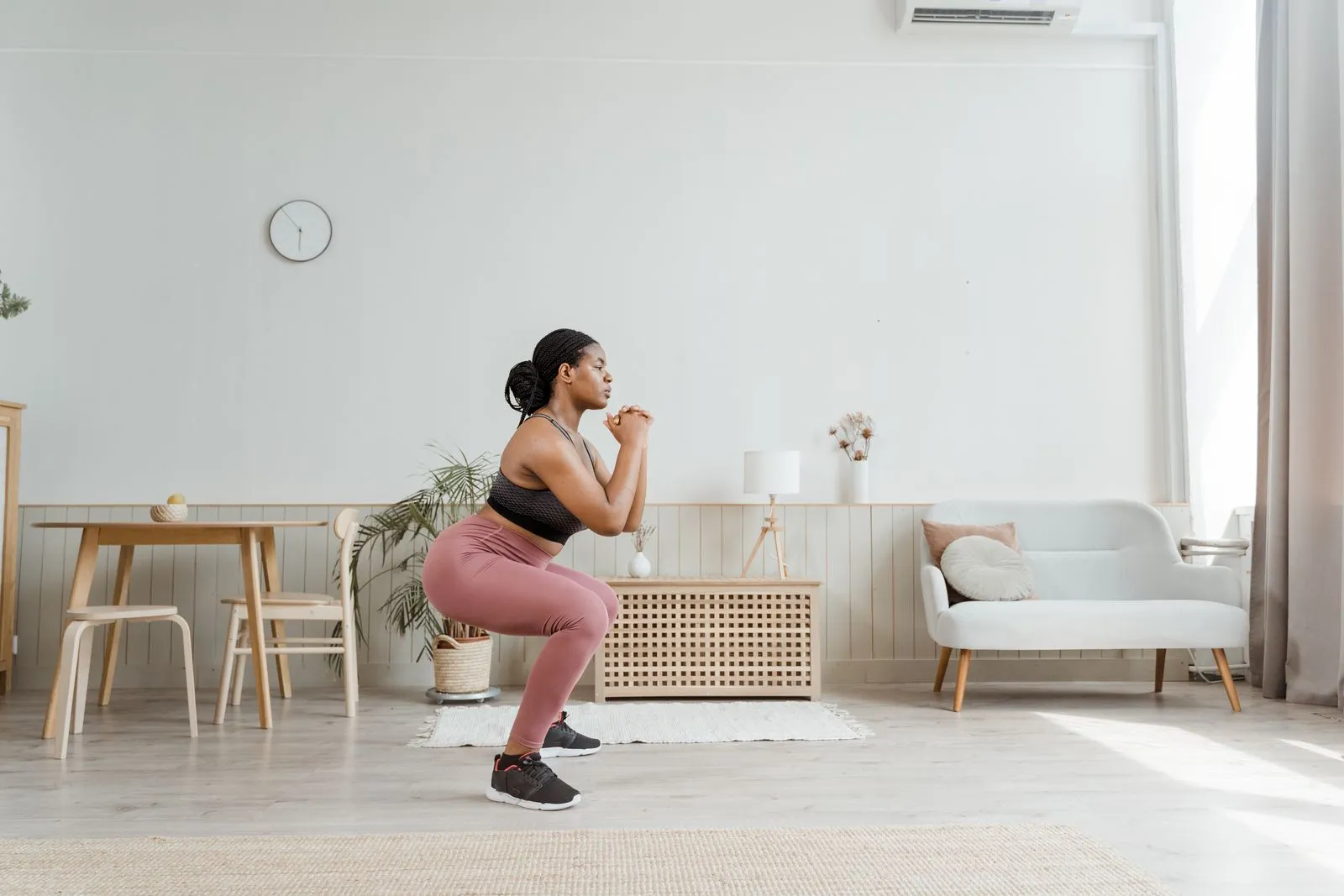
- Ten bodyweight squats. Feet about shoulder width, sit back as if reaching for a chair behind you, stand up tall. This is the squat pattern and it wakes up the glutes and quads that have been switched off all day.
- Ten glute bridges. Lie on your back, knees bent, feet flat, and drive your hips up until your body makes a straight line from knee to shoulder. Squeeze at the top. This is your hinge, and it is the single most useful move on the list for a sitting body.
- Ten wall push-ups. Hands on the wall a little wider than your shoulders, body straight, lower your chest toward the wall and press away. This is the push. Move your feet further back to make it harder.
- Twenty-second plank. Forearms down, body in one line, ribs pulled gently toward your hips. Twenty honest seconds beats a minute of sagging. Stop when your lower back starts to dip.
- Ten band rows, or ten bent-over rows with anything weighted. Draw your elbows back and squeeze your shoulder blades together. This is the pull, the pattern a keyboard erases most completely, and the one that most directly counters a rounded upper back.
Two rounds is ten minutes including rest. If you have fifteen, do three. If you have five, do one round and count it, because one round done on a bad Tuesday is worth more than three rounds you keep postponing.
A note on order. The circuit runs legs, hips, chest, core, back on purpose. Alternating which area works means each muscle group gets a rest while another one runs, so you keep moving without needing long pauses. That is what lets five exercises fit inside ten minutes rather than twenty.
If you want to make it harder without adding time, slow the lowering phase. Take three seconds to descend into each squat and three to lower from each push-up. The set takes the same ten repetitions and asks considerably more of the muscle, which is the cheapest progression available to someone with no equipment.
What trips people up#
Going too hard on day one. The most common way this ends is not boredom, it is calves so sore on Wednesday that Thursday gets skipped. Start at a level that feels slightly too easy. You can add rounds in week two, and you will still be doing it in week six.
Waiting for a clear ten minutes. A clean, uninterrupted block rarely arrives in a working day. Split it instead. One round before your first meeting and one after lunch is the same ten minutes and it fits a real calendar.
Skipping the rows because you have no band. The pull is the pattern that matters most for a desk worker, so do not drop it. A heavy bag, a full water bottle in each hand, or a towel looped around a door handle all work. A resistance band is a few pounds and is the one piece of equipment worth owning.
Treating soreness as the scoreboard. Being sore tells you a movement was unfamiliar, not that the session was good. The sessions that build a body that feels better at a desk are usually the unremarkable ones you barely notice doing, repeated on weeks when nothing about them felt impressive.
Common questions
Is ten minutes really enough to get fitter?
For someone currently doing little, yes. Gibala's work at McMaster found sedentary people matched the fitness gains of 150 minutes of endurance training using a short interval protocol and about 80 percent less time. Ten minutes will not build a marathon base, but it moves the markers that matter most for a sitting body.
How many times a week should I do this?
Three non-consecutive days is a sensible target and enough to see change. Two is still worth doing. The circuit is light enough that daily is fine if you keep the intensity moderate, but most people hold three days more reliably than they hold seven.
Do I need to warm up first?
The first round is the warm-up if you keep it easy. Do the first set of squats at half effort and let the pace build. If you have been sitting for hours, add the twenty-second reset from Chapter 1 before you start.
What if I cannot get down on the floor for glute bridges?
Do standing hip hinges instead: feet hip width, soft knees, push your hips back as if closing a car door with them, then stand tall and squeeze. You keep the hinge pattern, which is the part that matters, without needing the floor.
Tools that make this stick
Where an expert named a specific tool, that is noted. The rest are practical options, and at least one of them is always free.
A free five-week audio programme of equipment-free strength and flexibility sessions.
If you want the circuit in this chapter but with someone counting you through it, this is the closest free equivalent. It assumes no equipment and no experience, and it progresses over five weeks rather than dropping you in.
A workout app with a large library of guided sessions, including short bodyweight ones.
Useful when the barrier is deciding what to do rather than finding time. Filter to ten minutes and bodyweight and you get a session picked for you, which removes the one decision most likely to stall a short window.
- A resistance bandLow cost
A single loop or tube band, usually a few pounds or dollars.
The pull is the pattern a desk job erases most completely and the hardest one to load without equipment. This is the only piece of kit in the whole series worth buying, and it makes the row in the circuit meaningfully better.
Your one move today
Stand up and do ten bodyweight squats right now. Sit back as if reaching for your chair, stand tall, repeat. It takes forty seconds and it is the single move that most directly undoes the last three hours of sitting.
Next in this series
3How do I stay consistent with movement when work gets busy?Knowing the workout is the easy part. Chapter 3 is about the harder question of doing it in a week that keeps falling apart.New chapters go up as they are written. If you would rather not have to remember to come back, the homepage lists every series in order, so you can pick up wherever you left off.
Sources
Every quote on this page was checked against its original source before publishing.
- Martin Gibala, PhD - Professor of Kinesiology, McMaster University; interview on time-efficient interval training, CBC News View source
- Emmanuel Stamatakis, PhD - Professor at the University of Sydney; VILPA research on short activity bursts, reported by the University of Sydney and published in JAMA Oncology View source
- Dan John - strength coach; the five basic human movement patterns, On Target Publications View source
- Dr Rangan Chatterjee - GP and author; the five-minute kitchen workout, on his own site View source