What can I do every time I stand up from my desk?
Every time you stand, do a 20-second reset: five hip openers, five slow calf raises, and one overhead reach. It reverses the three things sitting tightens most, which are your hips, your calves, and a rounded upper back, before they have a chance to stiffen.
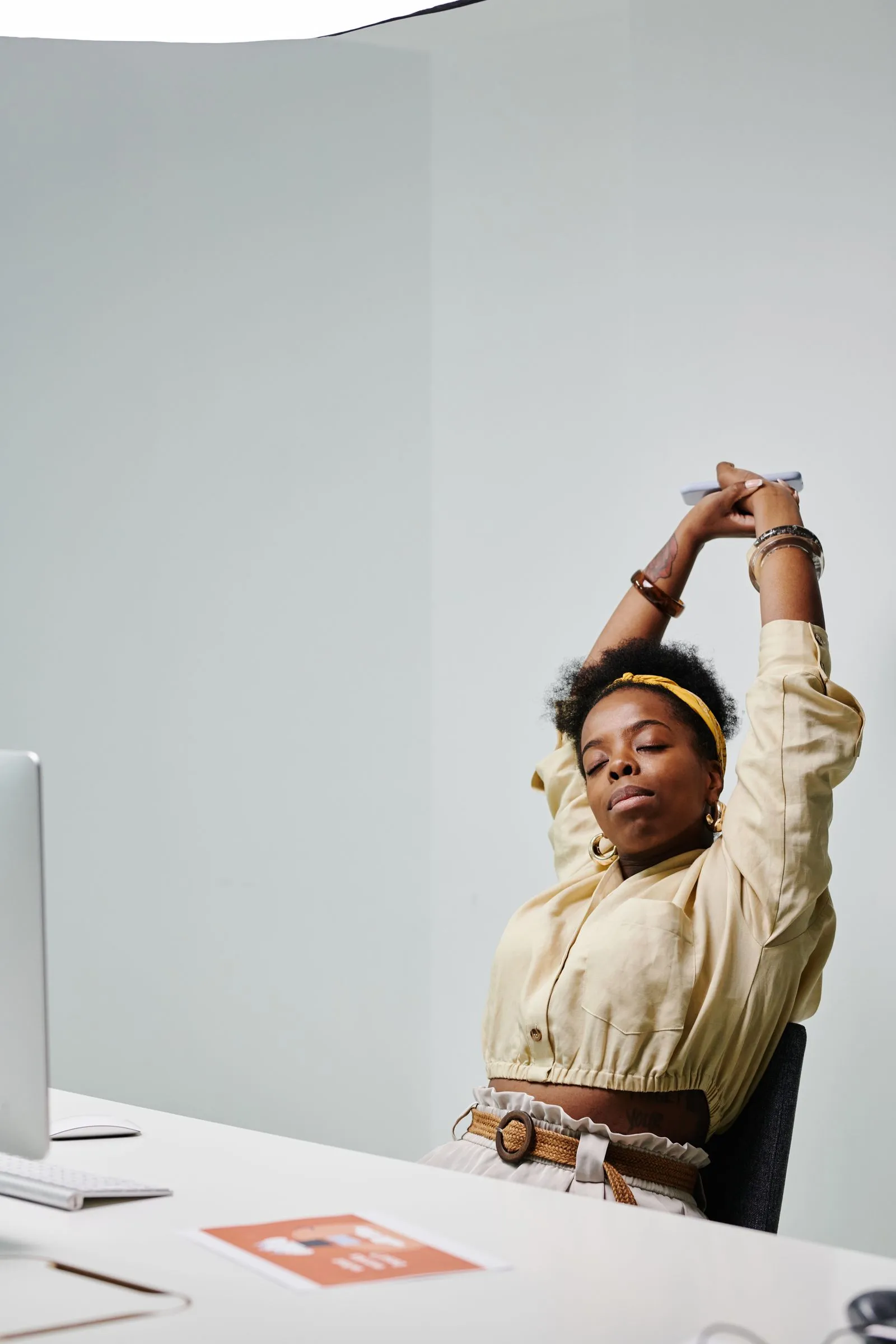
It is 3pm. You have been in the chair since nine, your hips feel welded to the seat, and the walk to the kettle is the most exercise your legs have seen all day. You are not unfit. You are just a person whose job happens to involve sitting still for eight hours.
Here is the useful part. You already stand up several times a day, for water, for the bathroom, for a call you can take on your feet. Those moments are free. This chapter turns them into the smallest possible piece of training, and it takes twenty seconds.
Why the moment you stand up is the one that counts#
Most advice about desk work asks you to add something: a gym session, a lunchtime run, an hour you do not have. The reason that advice fails is not laziness. It is that it competes with your calendar, and your calendar wins.
Standing up does not compete with anything. You were already doing it. Attaching a few seconds of movement to something you already do is the cheapest habit in the book, because there is no new decision to make and no new time to find.
What happens in your body when you sit for hours#
Three things go quiet when you sit, and they are the three the reset targets.
Your hips stop moving through their range. A seated hip is held at roughly ninety degrees for hours at a time. Muscles adapt to the position you keep them in most, so the tissue at the front of the hip gradually settles into that shorter length.
Your calves stop pumping. The calf is sometimes called the second heart because contracting it squeezes blood in the deep veins back up toward the chest. Sitting switches that pump off almost completely, so blood pools in the lower legs.
Your upper back rounds forward. A keyboard pulls your arms and shoulders in front of you. Hold that shape long enough and the chest tightens while the muscles between the shoulder blades lengthen and switch off.
None of this is damage. It is adaptation, and it reverses in the other direction just as readily once you give the body the opposite signal.
That last point is worth sitting with, because the language around desk work tends toward the apocalyptic. You have probably read that sitting is the new smoking. It is a useful headline and a poor description. Smoking has no dose at which it helps you. Sitting is a neutral position that becomes a problem only when it is the only position you occupy, and the fix is not to stop sitting but to stop sitting uninterrupted.
The research: how often you move matters more than how hard#
Keith Diaz, a behavioural medicine researcher at Columbia University, studies exactly this question. His framing of the problem is blunt.
We've built a world that rewards stillness.
His laboratory set out to measure what undoes it. Participants sat for eight hours while researchers compared five patterns of walking breaks: one minute of walking every thirty minutes, one minute every sixty, five minutes every thirty, five minutes every sixty, and no walking at all.
Five minutes of walking every half hour came out on top. It cut the blood sugar spike after eating by 58 percent compared with sitting all day. Every walking pattern tested, including the one-minute versions, lowered blood pressure by four to five points.
Why it works. Working muscle pulls glucose out of the bloodstream without needing much insulin to do it. A leg that has not contracted in three hours is not helping. A leg that contracts briefly every half hour keeps that clearance ticking over all day.
How you apply it at a desk. Five minutes every thirty is the laboratory ideal, not a rule you have failed if you miss it. The direction of travel is what matters. Standing and moving for twenty seconds several times a day is closer to the finding than doing nothing and feeling bad about it.
Why standing up beats standing still#
Joan Vernikos ran NASA's Life Sciences Division, where the job was working out why astronauts came back from orbit with the bodies of much older people. Her research pointed at something specific, and it is the reason this chapter is built around a transition rather than a posture.
In her bed rest studies, which simulate the effects of weightlessness on Earth, the useful signal was not time spent upright. It was the act of changing position. Standing up once an hour did more for cardiovascular and metabolic markers than a single longer bout of walking. Standing up thirty-two times across a day was not the same as standing up and sitting down thirty-two times in one go.
Why it works. Every time you go from sitting to standing, your body has to respond to gravity again. Blood pressure adjusts, the inner ear registers the change, muscles fire to hold you up. That repeated challenge appears to be the stimulus, and it goes silent when you hold any one position for hours, including standing.
How you apply it at a desk. This is quietly good news if you have been feeling guilty about not owning a standing desk. You do not need to stand all day. You need to stand up more often. Frequency is the lever, and it is free.
Why the reset uses three different movements#
Katy Bowman is a biomechanist whose work reframes movement as something closer to nutrition than to exercise. Her argument is that we track the quantity of our movement and ignore its range.
We need as much variety in our movement as we do in our food.
Her point lands hard on desk workers. A day of sitting followed by a run is a day with a lot of one movement and almost none of the rest. The hips never open sideways. The upper back never extends. The ankles move through a fraction of what they can do.
Why it works. Tissue adapts to the positions it visits. Loading a joint through its full range, even briefly and without weight, is the signal that keeps that range available to you.
How you apply it at a desk. This is why the reset is three unrelated movements rather than twenty of one. Each one visits a range that a chair takes away. Twenty seconds of variety does more for a stiff body than two minutes of the same motion.
What happens when a whole office tries this#
It is worth knowing whether any of this survives contact with a real workplace, as opposed to a laboratory where someone is paid to sit on a treadmill. Genevieve Healy, Professor of Physical Activity and Health at the University of Queensland, has spent her career on that question.
She leads BeUpstanding, an Australian workplace programme built for exactly our reader: desk-based teams, in normal jobs, with normal workloads. Its stated aim is to help workplaces stand up, sit less and move more. What makes it interesting is that it does not begin by handing everybody a standing desk.
Why it works. The programme treats sitting as a team habit rather than a personal failing. When one person stands up in a meeting it looks odd. When it is normal in the room, the social cost disappears, and the social cost is usually the real barrier rather than motivation.
How you apply it at a desk. You do not need a programme to borrow the idea. Say out loud to the one colleague you trust that you are getting up every hour. Take a recurring call standing. Once a second person copies you, the awkwardness is gone and the habit stops depending on willpower.
If you work alone or remotely, the equivalent is making it visible to yourself instead: a repeating timer, or simply keeping your water glass in another room so refilling it requires standing.
The 20-second reset, step by step#
Do this every time you are already on your feet. It needs no equipment, no floor space beyond where you are standing, and nobody will notice.
- Five hip openers per leg. Lift one knee and swing it out to the side and back, as if stepping over a low fence. Slow and controlled beats high and fast. This walks the hip through the sideways range that sitting removes entirely.
- Five slow calf raises. Rise onto your toes, pause for a beat at the top, and lower under control. The pause is the part people skip and the part that matters, because it is the contraction that drives blood back up your legs.
- One overhead reach. Interlace your fingers, turn your palms to the ceiling, press up and take one full breath in and out. This extends the upper back and opens the chest that your keyboard has kept folded shut.
That is the whole thing. Twenty seconds, three ranges, no equipment. Attach it to standing up for water or a call and it accumulates into real movement across a day without ever feeling like exercise.
What trips people up#
Trying to remember it. Memory is a poor trigger. Attach the reset to an event that already happens instead: every time you fill a water bottle, every time you stand for a call. The event does the remembering for you.
Deciding it is too small to matter. This is the most common reason people stop. Twenty seconds feels insignificant next to a gym session, so it gets skipped on the grounds that it is not real training. It is not training. It is maintenance, and the comparison is not against a workout, it is against continuing to sit.
Doing it once, thoroughly, at 6pm. A long stretch at the end of the day is a pleasant thing to do and it is not what the research points at. Vernikos found the value in repeated transitions and Diaz found it in repeated breaks. Spread out beats concentrated.
If you have existing hip, knee, back or circulation problems, or you are pregnant, check with a physiotherapist or your doctor before adding new movements. Nothing here should hurt. Discomfort in a tight muscle is normal, sharp pain in a joint is not.
Common questions
What if I can't stand up often at work?
Do a seated version: squeeze your glutes for five seconds, pump your ankles up and down twenty times, and reach one arm overhead. You lose the standing transition that Vernikos found valuable, but you keep most of the circulation benefit from the calf and glute work.
Won't people notice me doing this?
Almost none of it is visible. Calf raises and glute squeezes read as standing normally, and the overhead reach looks like an ordinary stretch at a desk. The hip openers are the only obviously deliberate move, and those take five seconds by a wall or in a corridor.
How often should I be getting up?
The Columbia study found five minutes of walking every thirty minutes was optimal, but every pattern they tested lowered blood pressure, including one minute every hour. Once an hour is a realistic target for most desk jobs and still lands inside what the research supports.
Does a standing desk make this unnecessary?
No, and this is the useful surprise in the NASA research. Holding any single position for hours is the problem, standing included. A standing desk helps only if you keep changing position at it.
Tools that make this stick
Where an expert named a specific tool, that is noted. The rest are practical options, and at least one of them is always free.
- BeUpstandingFree
A free workplace programme from the University of Queensland for desk-based teams.
This is the one to start with if the barrier is social rather than personal. It gives a team a shared reason to stand up, which removes the awkwardness of being the only person in the room who moves.
Recommended by Genevieve Healy, who leads the programme at the University of Queensland
- StretchlyFree and open source
An open-source break reminder that sits in your menu bar on Windows, macOS and Linux.
Its default schedule is a 20-second micro break every 10 minutes and a 5-minute break every 30, which lines up almost exactly with what the Columbia team found optimal. Set the long break as your cue for the reset.
- NHS Active 10Free
A free walking tracker from the NHS that measures brisk minutes rather than steps.
Steps reward shuffling around a kitchen. This measures intensity, which is the variable that mattered in the research, and it runs off your phone sensors with no account to create.
Your one move today
Right now, before you read anything else, stand up and do five slow calf raises next to your chair. Rise, pause at the top, lower slowly. That is twenty seconds and that is chapter one, applied.
Next in this series
2What's a good 10-minute workout for someone who sits all day?Once standing up is automatic, the next question is what to do when you have ten actual minutes.New chapters go up as they are written. If you would rather not have to remember to come back, the homepage lists every series in order, so you can pick up wherever you left off.
Sources
Every quote on this page was checked against its original source before publishing.
- Keith Diaz, PhD - interview on sedentary behaviour and movement, Irving Institute, Columbia University View source
- Duran et al., 2023 - trial finding five minutes of walking every 30 minutes cut post-meal blood sugar spikes by 58 percent, Medicine & Science in Sports & Exercise, reported by Columbia University Irving Medical Center View source
- Joan Vernikos, PhD - former Director of Life Sciences at NASA; bed rest research on gravity and postural change, summarised in Sitting Kills, Moving Heals View source
- Katy Bowman - interview on movement variety and nutritious movement, Health Club Management View source
- Professor Genevieve Healy - Professor of Physical Activity and Health, University of Queensland; leads the BeUpstanding workplace programme for desk-based teams View source